

NKE 0.00%↑ is taking an absolute beating.
This is the type of stock that will show up on my radar when I look for undervalued stocks. A storied brand, a stable-looking business on the surface and a historical compounder.
However, there are big issues under the surface that need to be addressed by investors. Whether they are structural in nature or a discrepancy between value and price is what we have to figure out. Most people know that NKE 0.00%↑ makes shoes and athletic wear, but it helps to contextualize the analysis by saying that NKE 0.00%↑ is a footwear company first and foremost.
Competitors have been trying to encroach on that valuable footwear moat for the longest time. A misstep by Nike management seems to have given them this foothold on a silver platter. But before I get into how NKE 0.00%↑ stumbled, let’s try to understand the business the best we can.
Nike’s Business and Industry Dynamics
Historically, NKE 0.00%↑ drove demand through aggressive marketing, athlete sponsorships, and creating artificial scarcity for limited-edition sneakers (think Jordans and Dunks). The sportswear and athletic footwear industry is massive but incredibly crowded.
For decades, it was basically a two-horse race between Nike and Adidas, with a few smaller players fighting for scraps. I remember growing up in the 90’s with plenty of Nike shoes; they always seemed cooler than Adidas for me back in the day. Jordan’s, a shoe born out of a brand collaboration between Michael Jordan and Nike, jump-started the sneaker culture in the 80’s and 90’s.
Fast forward to today and the landscape is heavily fragmented. Consumers seem to be putting a premium on comfort, running tech, and ath-leisure. The barriers to entry have lowered with so many planes for customer engagement and sales, and specialty running brands have aggressively eaten into the everyday lifestyle market.
So How Did We Get Here?
Well the most obvious factor is the switch to Direct-To-Consumer (DTC) initiatives just before the Covid era. In 2020, they launched the “Consumer Direct Acceleration” plan. They removed many physical stores and cut ties with many wholesalers like DSW and Foot Locker.
The plan was to remove third-party retail spaces, aka the middleman, and then push people to their own Nike.com, Nike app and the SNKRS app. Why? Well, this seemed like a very logical move for several reasons:
Higher Profit Margins: Selling directly to a consumer online means NKE 0.00%↑keeping the entire retail price instead of selling a shoe at a 50% wholesale discount to the middleman store which are the retail spaces.
Data Ownership: Operating via their first-party app allows NKE 0.00%↑ to collect direct customer data on browsing and purchasing habits, enabling hyper-personalized marketing.
Brand Control: Treating it’s sneakers like luxury tech products rather than items stuffed onto crowded, un-inspiring retail walls. This is where their limited edition rollups and collabs were fitting in.
What occurred afterwards might as well be written in economic textbooks as a case study on giving up a competitive advantage. They lost the foot-traffic and casual customer who likes to buy shoes at the store. Many sneaker-heads like to shop in person for good deals in a physical store. In addition, the margins of trying to manage digital marketing, shipping, returns, and warehousing were unsustainable.
But probably the worst outcome was that those wholesalers needed to fill their shelves with something. And that something turned out to be all of Nike’s competitors. On Running, Hoka, and New Balance got a huge leg-up from the vacancy that Nike left by their own omission. This was the foothold that all these companies needed to destroy the moat of NKE 0.00%↑.
NKE 0.00%↑ is still the biggest player however, holding roughly 23-27% of the global athletic shoe market share as of early 2026. But they are bleeding ground to niche competitors who hyper-focused on running and comfort.
Another less tangible point I want to make is that the Jordan brand line may not have as much resonance with younger shoppers. Millennials and older customers feel a connection to the shoe in a different way than someone born after 2000. Most of the younger generation would not have seen Michael playing in the 90’s at the peak of his career.
Management Guidance & Turnaround Strategy
In October 2024, NKE 0.00%↑ realized the DTC strategy wasn’t working and brought back company veteran Elliott Hill as CEO.
Hill’s strategy—dubbed “Sport Offense”—is basically a back-to-basics playbook. He is heavily focused on repairing the burned bridges with wholesale partners, clearing out excess inventory, and getting Nike back to it’s roots in product innovation and sports marketing.
He also acknowledged that the brand isn’t living up to it’s potential, and management has initiated a massive cost-cutting program, including supply chain reductions and layoffs aimed at saving cash through the end of 2026. So far these efforts have not supported the stock price as it falls to 52-week low after 52-week low.
What About Their Financials?
Of the $11.3B they made last quarter, they kept $4.8B in gross profit and $712M in net income as seen below. Revenue growth and EPS growth are down QoQ and flat to down YoY. These are not the ideal numbers you want to see from a self-proclaimed growth company.
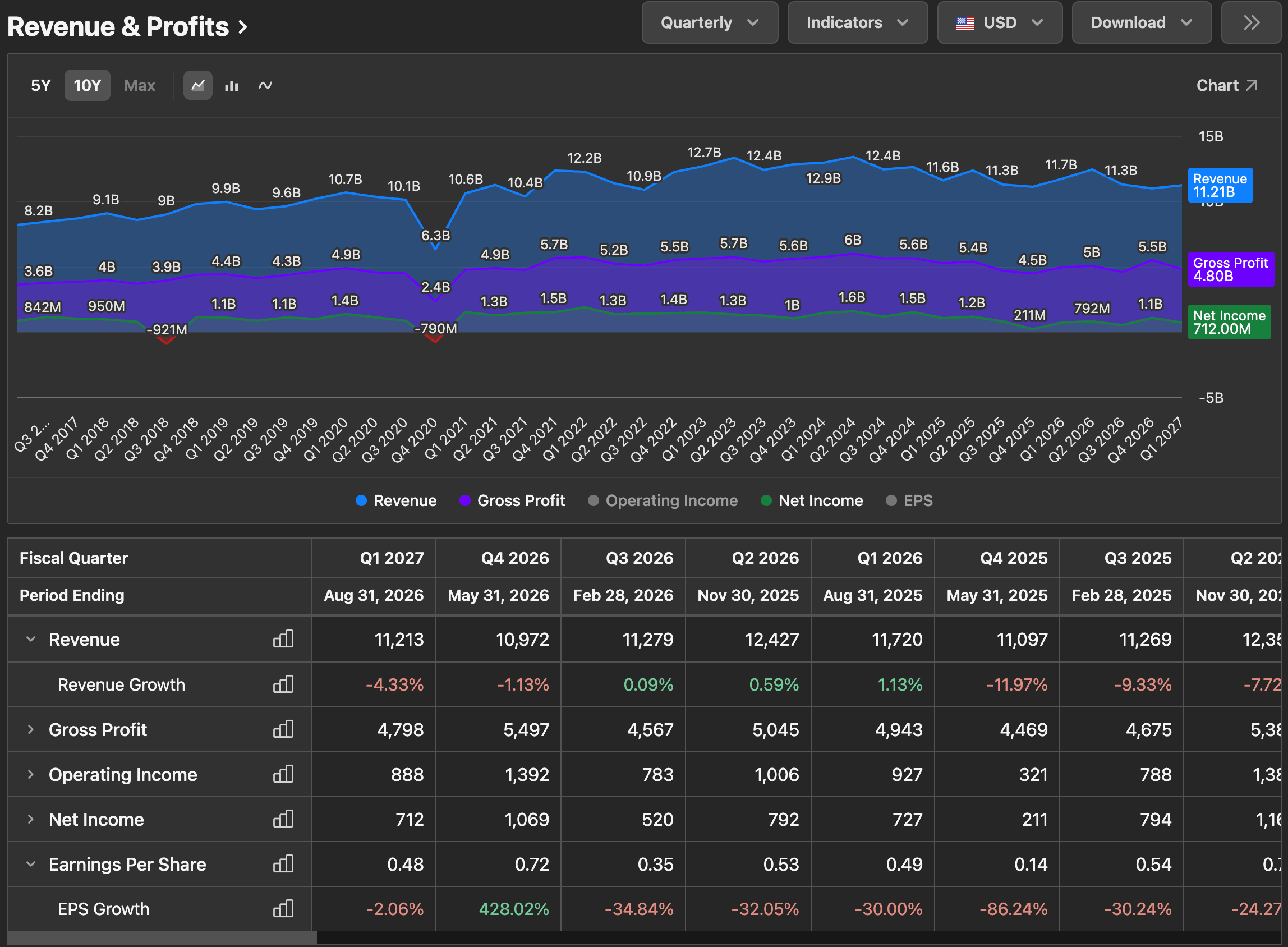
It’s clear that many of the factors I discussed above have put a massive dent in the financials of the business.
Looking at their revenue mix by segment, we can see the majority of their revenues are from footwear at $6.95B last quarter, followed by Apparel at $3.38B and then some minor revenue from Equipment, Global Brand Division and Converse.
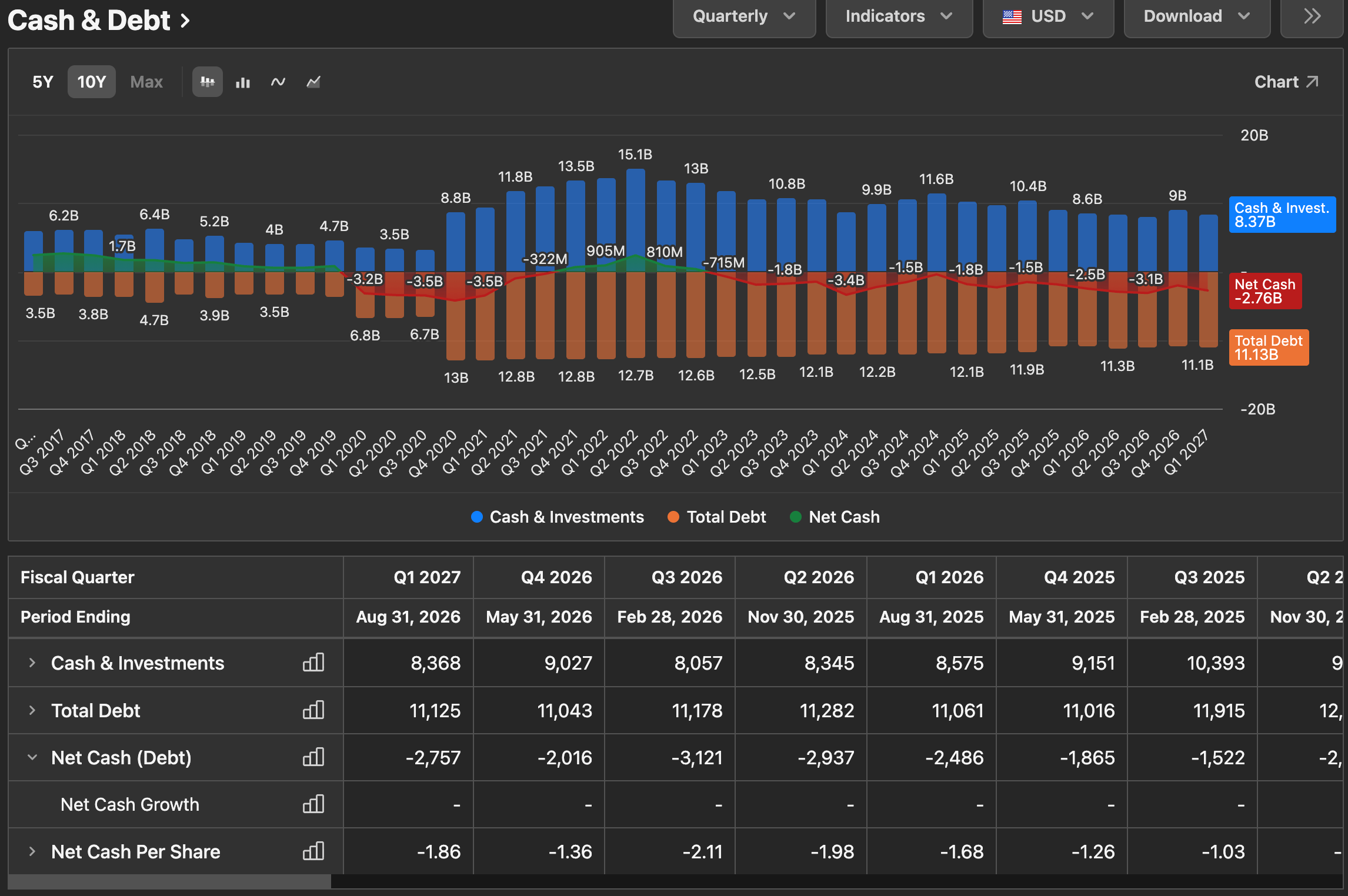
Cash and debt are not great as they have a net cash position of -$2.76B with $8.37B in cash and $11.13B in total debt. Free cash flow was negative for last quarter at -$64M because operating cash flows of $135M could not cover their capex of -$199M.
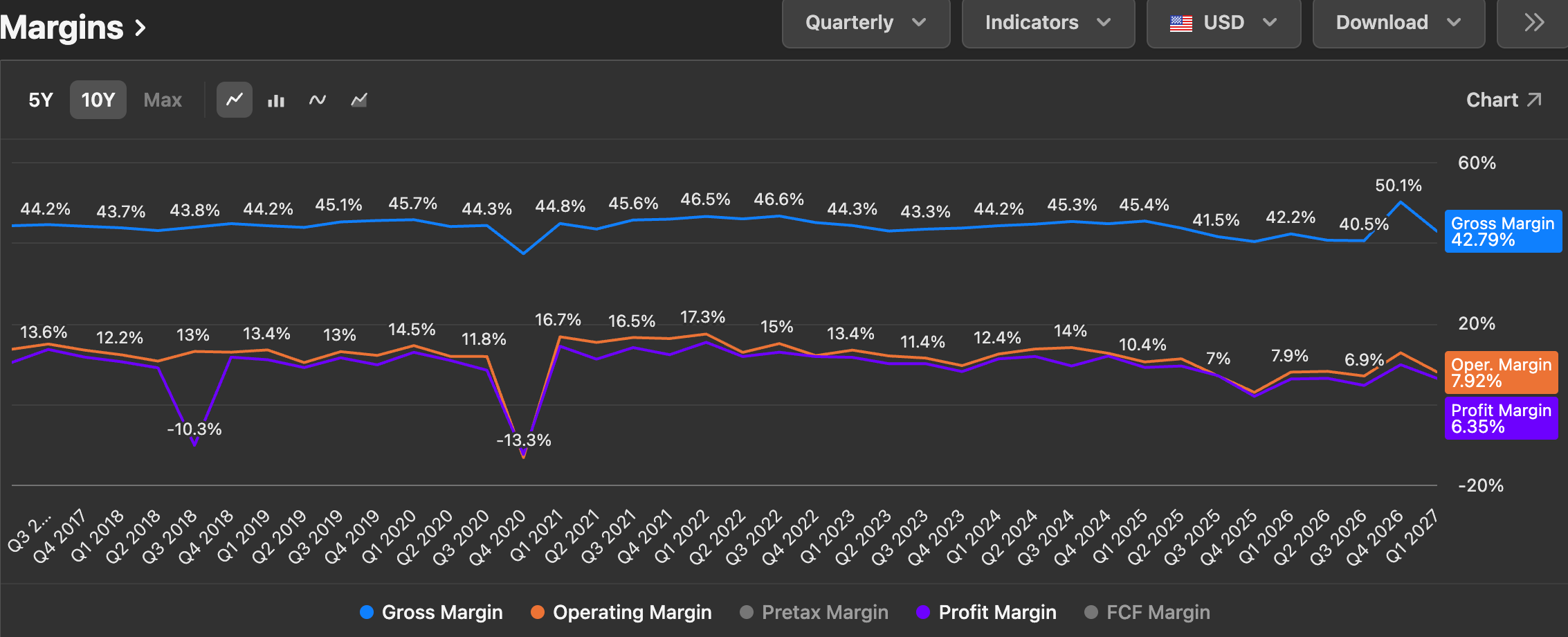
Finally their gross margin is pretty steady around the 40-45% range, but their operating and profit margins have been declining for many quarters now.
Financial Ratios & Valuation
Because the stock price has fallen so drastically, you would think that NKE 0.00%↑ would be a steal deal with a super low PE. Well you would be wrong. Because the growth is slowing as well, it has propped up the PE even in the midst of their downturn.
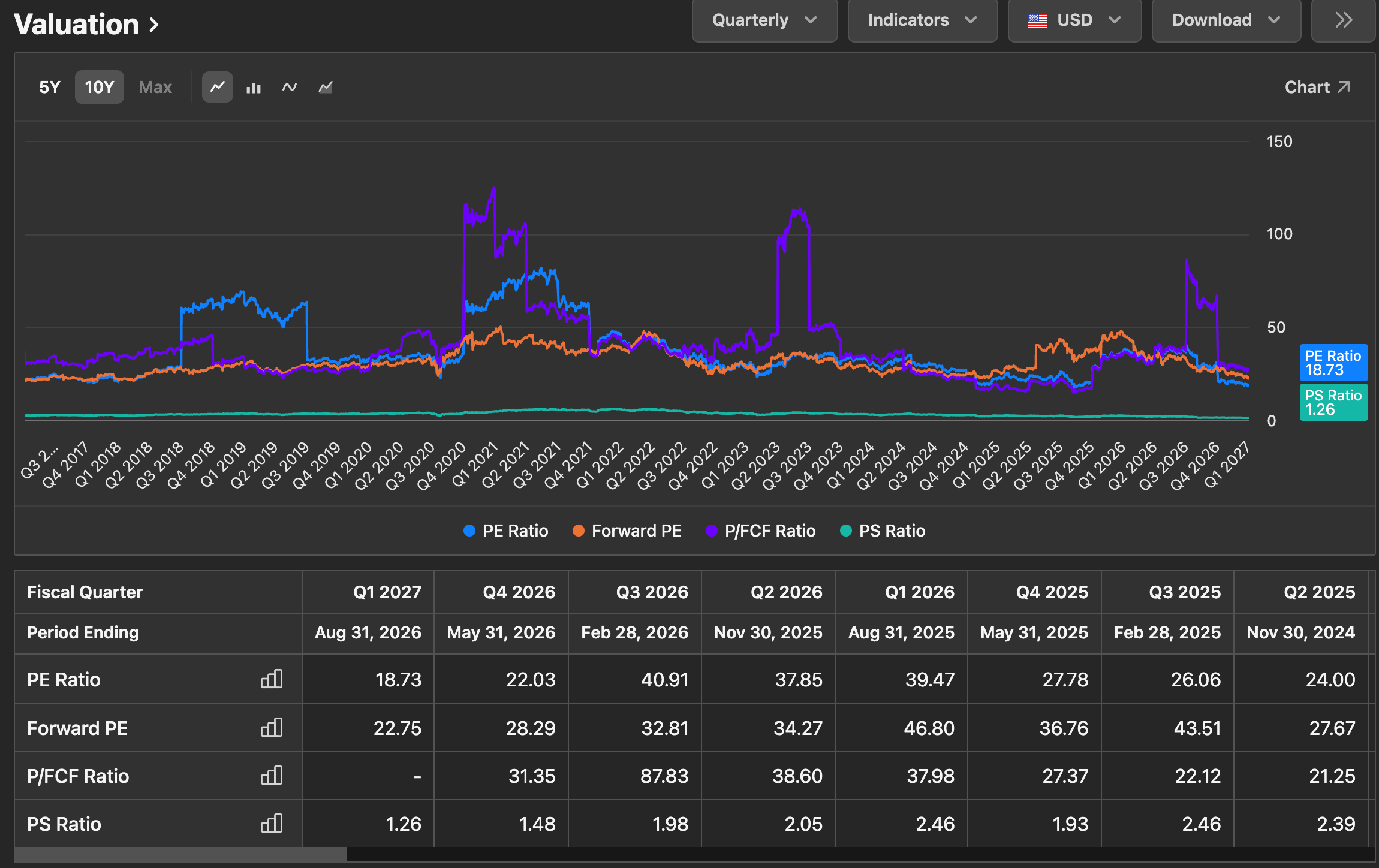
The forward PE is at 22.75 as of last quarter showing how much deceleration is being anticipated in earnings growth. Analysts are anticipating a 12-month price target of $38.15 which represents a 11.52% upside from current prices.
The range of analyst price targets is varied with a high target around $94 and low target at $19. Most likely those high targets will get revised down with continued deceleration in the financials of the company.
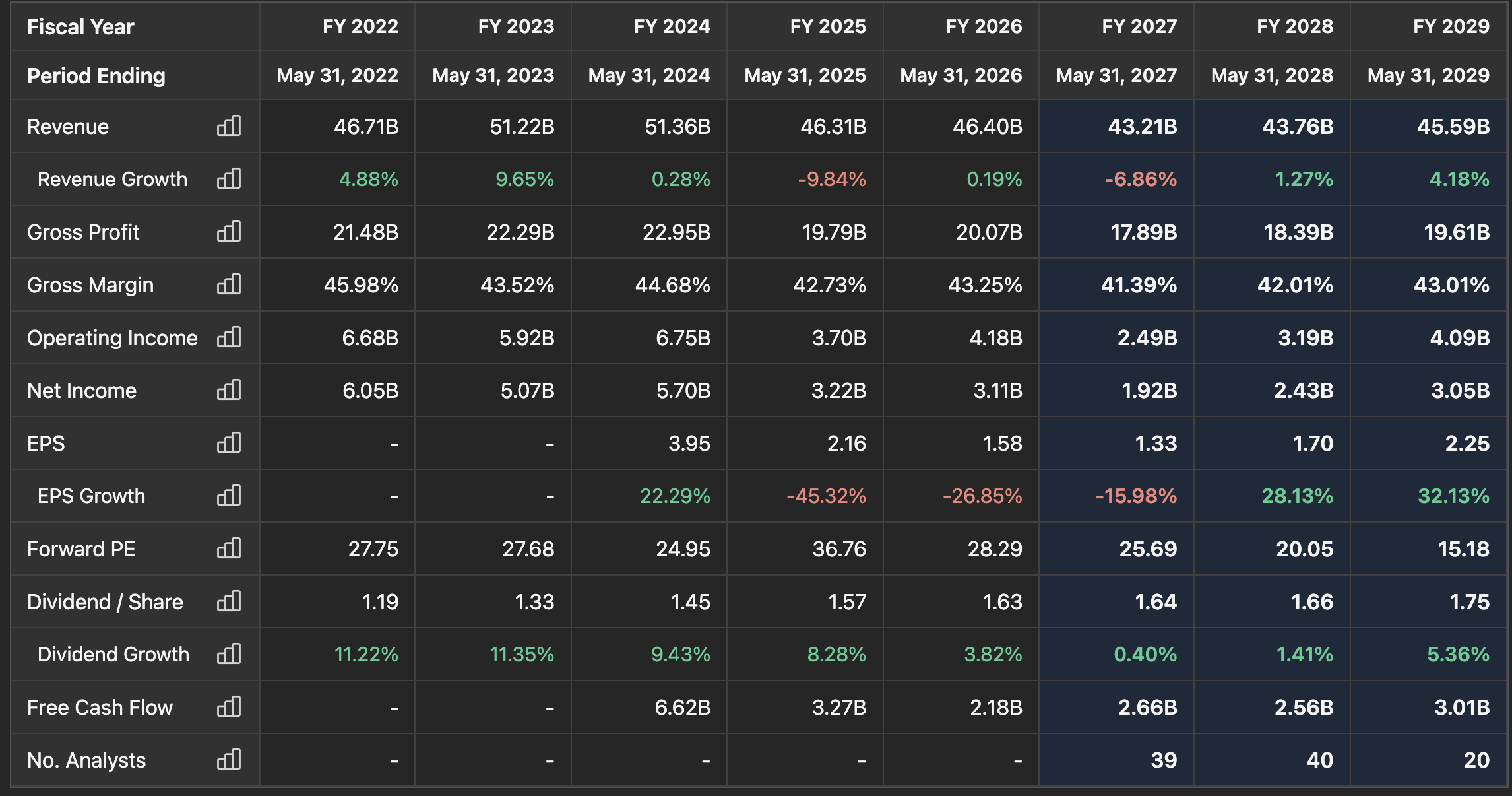
Importantly, analysts are anticipating deceleration in FY 2027 at -6.86% revenue growth and -15.98% EPS growth. From there, those same analysts are seeing very low revenue growth and higher EPS growth (which is high based on the low comps).
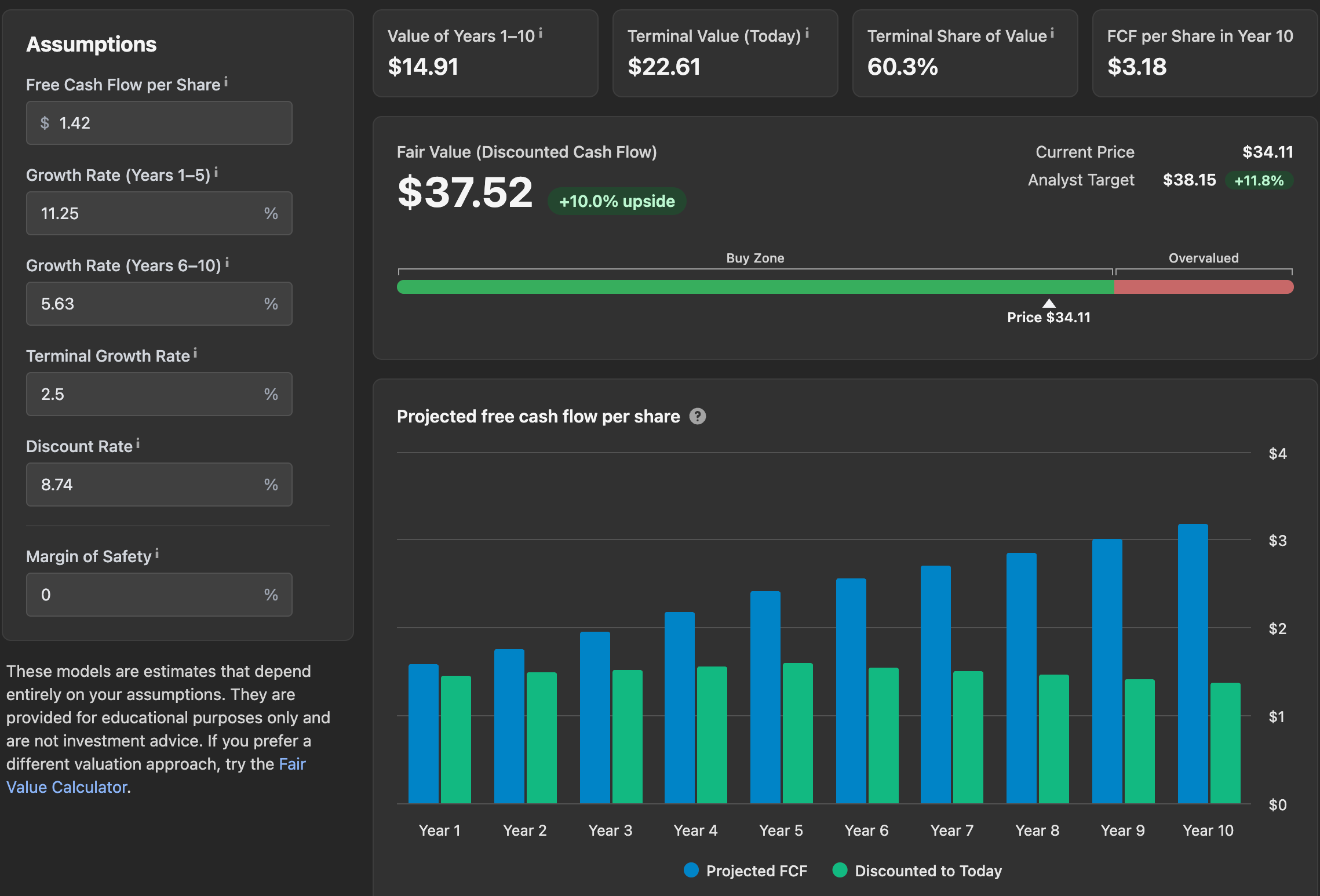
Using the new DCF feature on stockanalysis.com, I’m able to quickly calculate an intrinsic cash flow value for the business. Using a FCF/share value of $1.42 as well as a growth rate of 11.25% and 5.63% for front years and back years, respectively, we derive almost the same value as analysts from the 12-month price target.
At a $37.52 intrinsic value using current and trailing twelve month data, NKE 0.00%↑ only has a 10% upside with no margin of safety baked in. This does not take into account further deterioration of financials and fundamentals.
The bull case would be that management successfully rebuilds the wholesale network, new product cycles catch on, brand partnerships are restored, and margins expand again.
Another possible scenario is a buyout by a competitor which would be a short term bump in price but could be at the cost of long-term compounding if the acquiring company does not execute the acquisition well.
However, the bear case is that their sneaker market moat is permanently eroded and brands like Hoka and On have stolen the shelf space that Nike voluntarily gave up. For me, investing in a consumer brand which waxes and wanes with consumer fads and trends is already difficult. But combine that with the calculated intrinsic value deteriorating financials, I will most likely not be investing in this name.
But! Please let me know what you think about NKE 0.00%↑ in the comments below and if you are not subscribed to my publication yet, please consider doing so!
As always, my content is not financial advice so please do your own due diligence when investing your own money.