Let’s rip the band-aid off before we get into the full picture.
Celsius reported Q2 2026 earnings on August 6th, and it was the kind of print that makes momentum investors head for the exits.
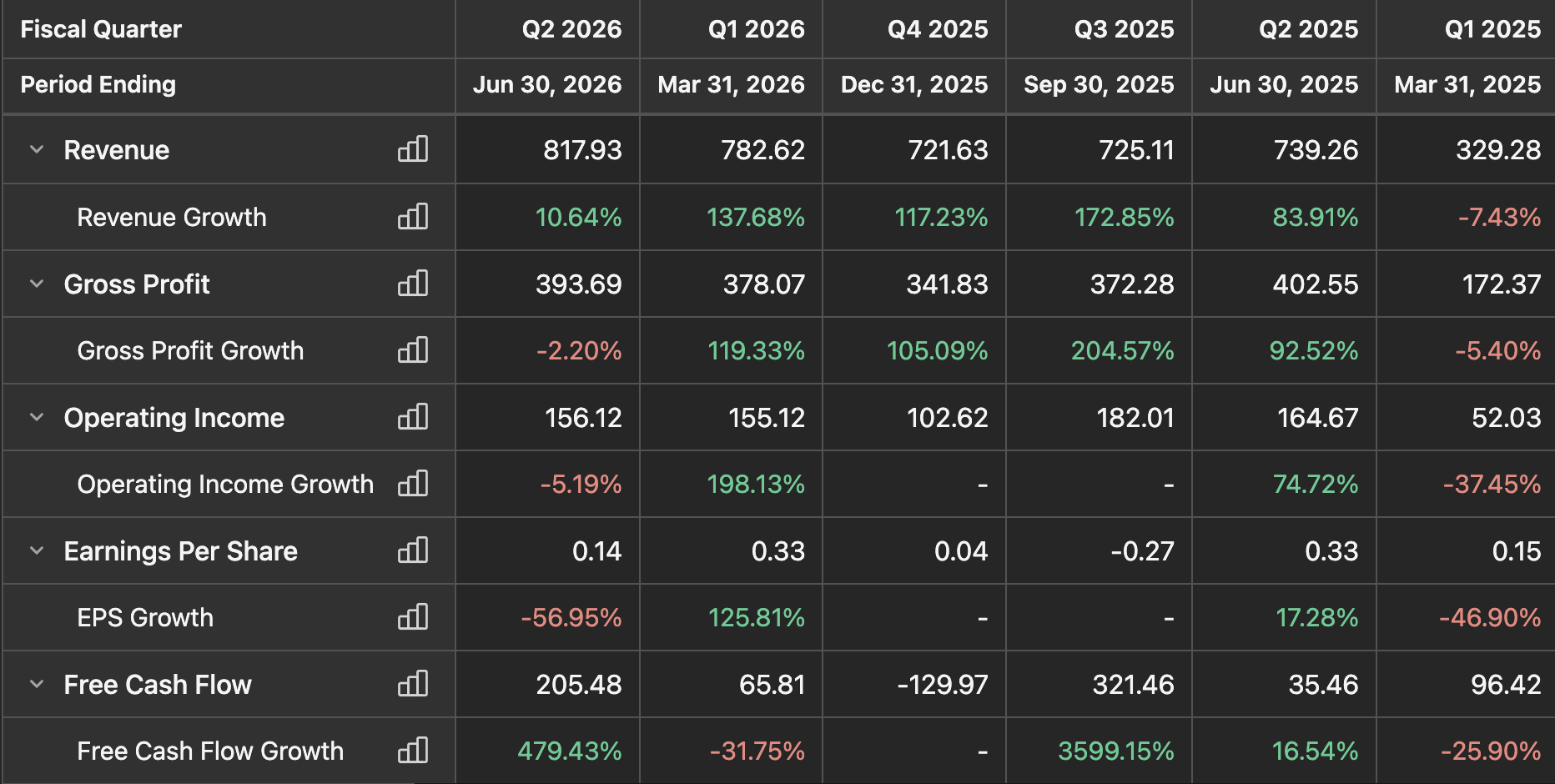
Revenue: $817.9 million (up 10.6% YoY, but missing consensus estimates of $886 million).
Adjusted EPS: $0.36 (missing the $0.43 estimate).
Gross Margin: Compressed to 48.1% from 51.5% a year ago, pressured by aluminum inflation, freight costs, and the margin dilutive nature of integrating newly acquired brands.
But the consolidated numbers only tell half the story.
The real concern for Wall Street was the apparent stagnation of the Celsius flagship brand. Net sales for the core Celsius brand fell by nearly 12%. Management attributed this to elevated promotional spending, inventory rebalancing, and a deliberate SKU optimization phase to clear out underperforming flavors.
We, as the intelligent investors that we are, have to determine whether management remarks on the core Celsius brand are valid.
However, what is known is that the market’s reaction was ruthless. Shares plunged 18% following the print, extending a brutal drawdown from their pandemic-era highs. But the stock caught a massive 12% intraday bid on August 7th.
The catalyst was someone from energy drink past.
In one of the most fascinating corporate ironies in recent memory, Russ Savage is staging a hostile intervention.
Savage founded Rockstar Energy out of his condo in 2001, built it into a global juggernaut, and sold it to PepsiCo in 2020. Since Celsius acquired the North American rights to Rockstar from PepsiCo last year, Celsius now technically owns the brand Savage birthed.
On August 7, 2026, Savage went on CNBC and said he had quietly amassed over 12 million shares (a 4.7% stake) and has been planning a leadership change within CELH 0.00%↑.
His grievances are textbook activist complaints, but we do need to make sure that CELH 0.00%↑ is not guilty of his claims.
He argues that under CEO John Fieldly, Celsius has bloated its management layers, lost operational discipline, and, most criminally in the beverage game, surrendered precious retail cooler space to rivals Red Bull and Monster.
“Once you lose shelf space, you’re dead,” Savage told CNBC. “The chains will give it to Red Bull or Monster... The CEO has lost credibility with the investment community. I’m publicly volunteering to do it.”
Savage claims he’s been quietly advising Celsius on cost cuts and marketing for a year but was ignored. Now, he’s leveraging his $300M stake to demand the ouster of Fieldly, the COO, and top marketing chiefs.
Whether this turns into a formal proxy fight or forces a boardroom compromise, the “activist overhang” establishes a psychological floor for the stock. Wall Street likes a turnaround story, especially when it’s spearheaded by a billionaire founder-operator with deep pockets.
To understand Celsius today, you have to understand it as a holding company executing a three-pronged demographic strategy.
Celsius: Positioned for the clinical, fitness-focused “better-for-you” consumer. It’s a 9.9% market share brand that is currently going through growing pains. It hit a saturation point in club channels and is now trying to reset its baseline.
Alani Nu: Acquired for $1.8 billion in April 2025, Alani Nu was the smartest thing management did. Founded by Katy Hearn, it targets the female, lifestyle, and Gen-Z demographic. In Q2 2026 alone, Alani Nu generated over $364 million in revenue, with retail sales soaring 56%. At a 9.0% market share, it is effectively neck-and-neck with the core Celsius brand. It is entirely carrying the company’s top-line growth right now.
Rockstar: Acquired in August 2025 as part of an expanded partnership with PepsiCo (which took another massive chunk of CELH 0.00%↑ equity to help fund the deal). Rockstar is a traditional, legacy energy brand. It gives CELH 0.00%↑ a horse in the race against standard MNST 0.00%↑ and Red Bull, but it’s a sliding asset. Retail sales for Rockstar were down 13% earlier this year, sitting at roughly 2.0% market share. It is the price of admission for building a scaled, Pepsi-powered platform.
Add it up, and Celsius Holdings commands approximately 20% of the U.S. RTD energy dollar share—meaning 1 in 5 energy drinks sold in America belongs to them.
Celsius is running a strategy that mirrors Monster Beverage’s historic rise, but on an accelerated timeline which is something that I like.
Just as Monster partnered with Coca-Cola to achieve global scale, CELH 0.00%↑ partnered with PepsiCo. Pepsi handles the direct-store delivery (DSD), allowing CELH 0.00%↑ to penetrate convenience stores, gas stations, and international markets with unprecedented speed.
MNST 0.00%↑ bought CANarchy and Bang Energy to diversify. CELH 0.00%↑ bought Alani Nu and Rockstar to corner every demographic—from the gym-goer to the aesthetic Gen-Z lifestyle consumer, to the blue-collar traditionalist.
The U.S. market is fiercely saturated, but Celsius’s international footprint is still in it’s infancy compared to MNST 0.00%↑ or Red Bull. If management can successfully execute the Pepsi distribution model in Europe and Asia, the total addressable market multiplies overnight.
Management’s tone on the Q2 call was highly cautious. They guided that gross margins will likely stay stuck in the high 40% range for Q3, weighed down by the Alani Nu/Rockstar integrations and stubborn aluminum prices. Furthermore, they explicitly signaled that the core brand might not return to sustained, normalized growth until 2027.
So, what are you paying for the stock today?
At roughly $32.50 per share and a forward PE of ~24.5 anticipated, CELH 0.00%↑ is valued far away from it’s 2023-2024 peak (when it routinely traded at P/E ratios well over 100x).
For a consumer staple holding company that effectively acts as a duopoly challenger to Monster/Red Bull, a ~20x forward multiple is historically cheap. You are getting the hyper-growth of Alani Nu for free, assuming they can simply stop the bleeding on the core Celsius brand which we have addressed in management comments above.
Looking at the average of 24 analyst estimates, the consensus is a Buy at $42.05 per share which would be a ~27.5% upside from here. Looking at the revenue growth over the next few years, there does seem to be a deceleration. However, gross margins seem to be stable with net income and free cash flow growing over the same period.
Celsius Holdings in late 2026 is a turnaround story.
The easy money of the early 2020s hyper-growth phase is gone. Now comes the hard work of portfolio management, SKU rationalization, international expansion and margin defense.
The Bull Case is where Alani Nu continues to print money, the core Celsius brand stabilizes by year-end, and Russ Savage’s activism either forces a lean, ruthless operational restructuring or puts him in the CEO chair to execute it himself. At ~20x forward earnings, the downside is largely priced in.
The Bear Case is where the core brand’s 11.7% contraction wasn’t inventory rebalancing but a genuine loss of consumer interest. Fighting Red Bull and MNST 0.00%↑ on the shelf is a zero-sum game, and Savage is right—once you lose the cooler space, it rarely comes back.
If you have a stomach for volatility, CELH 0.00%↑ at these levels offers asymmetrical upside. The next two quarters will determine whether CELH 0.00%↑ secures it’s spot as the permanent third pillar of global energy drinks, or if it was just a pandemic-era boom.
My content is not financial advice and I do have a position in CELH 0.00%↑. Do your own due diligence before investing any of your own money.


