

Author Note: I owned BABA 0.00%↑ in the past when the AI trade was still nascent. I sold BABA 0.00%↑ in 2023 to invest in other tech names because of my concerns around the sentiment with China and less reward to risk when it ran up in price. It has peaked my interest once again as a potential investment.
BABA 0.00%↑ has been compared to the AMZN 0.00%↑ of China. And it’s no wonder why. They have the cloud business in AliCloud, the logistics business in Cainao, the e-commerce piece with Tmall and TaoBao. But add to that the AI labs, frontier LLM models, semiconductor/chips and so much more that it may be more apt to compare BABA 0.00%↑ to a combination of US big tech firms, not just AMZN 0.00%↑.
I think it would be helpful for my readers (and me) to understand the details of their business before we dive into the financials and more.
What Does Alibaba Actually Do?
BABA 0.00%↑ is a sprawling empire which if you want to invest in, you have to understand it’s pieces along with it’s strengths and weaknesses.
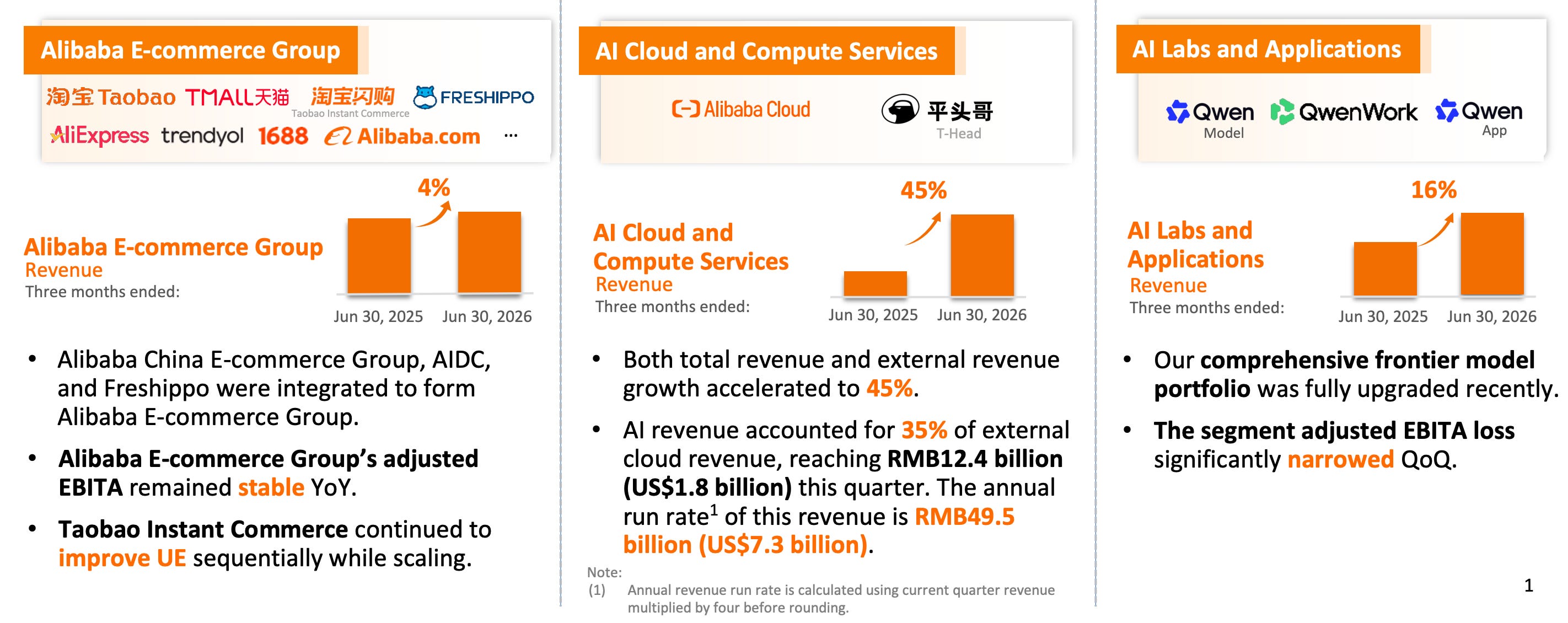
Prior to the August 2026 restructuring, they used 6 groups to organize the business. However, with the latest restructuring, they consolidated into 4 main business groups as shown below.
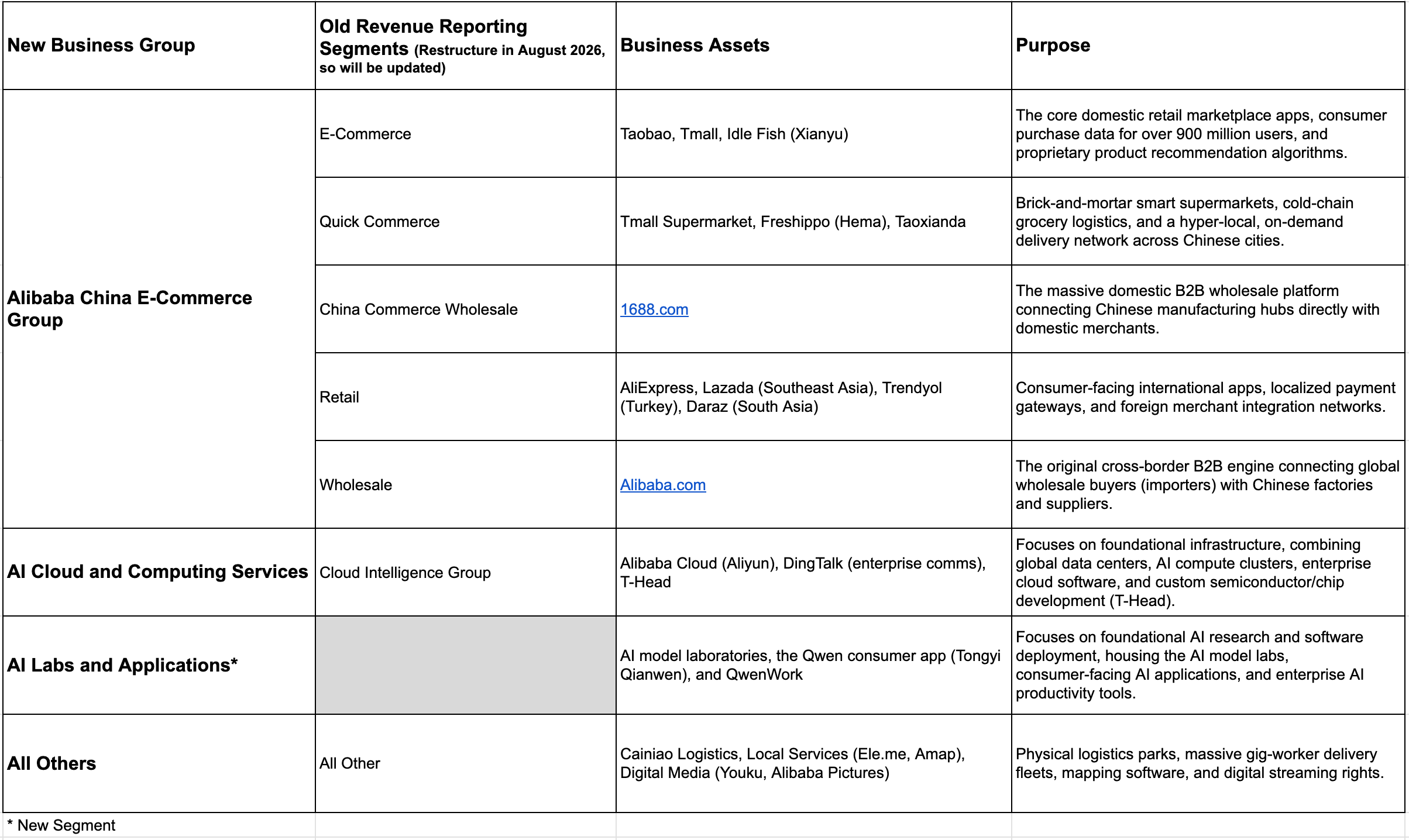
I’ve included the new business groups and how the current revenue segments are being reported until their next earnings report. One of the most important changes is the new AI Labs and Applications business group that houses the AI model laboratories and LLM models.
The other major changes are the new consolidated Alibaba China E-Commerce Group and T-Head (their semiconductor/chip development business) is now under the AI Cloud and Computing Services group along with Alibaba Cloud.
These 4 business groups are a more consolidated way to report similar business functions and operations. In their own words:

The main cash cow is still the e-commerce segment under Alibaba China E-Commerce Group especially going forward with the integration of domestic and international segments.
Using the old reporting format, you can see the revenue numbers for the different segments up till the restructuring.
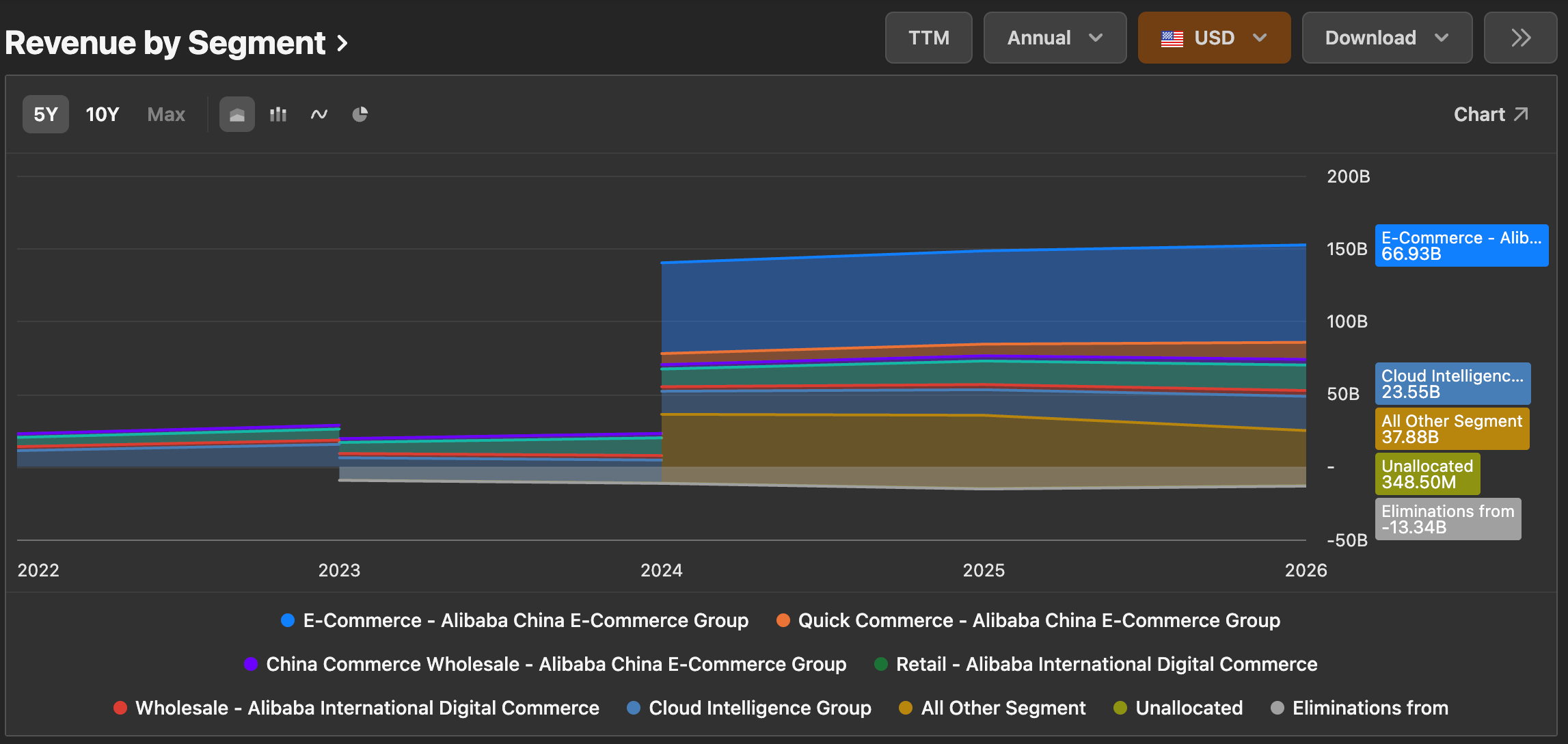
* A quick note here that “Eliminations from growth” are adjustments made to subtract internal transactions, divested operations and/or non-operating items so the reported numbers reflect true organic business expansion.
A Snapshot of Financials
Ok, so we have an understanding of the building blocks that make up BABA 0.00%↑ currently. I want to look at what their financials look like right now including their latest earnings report.
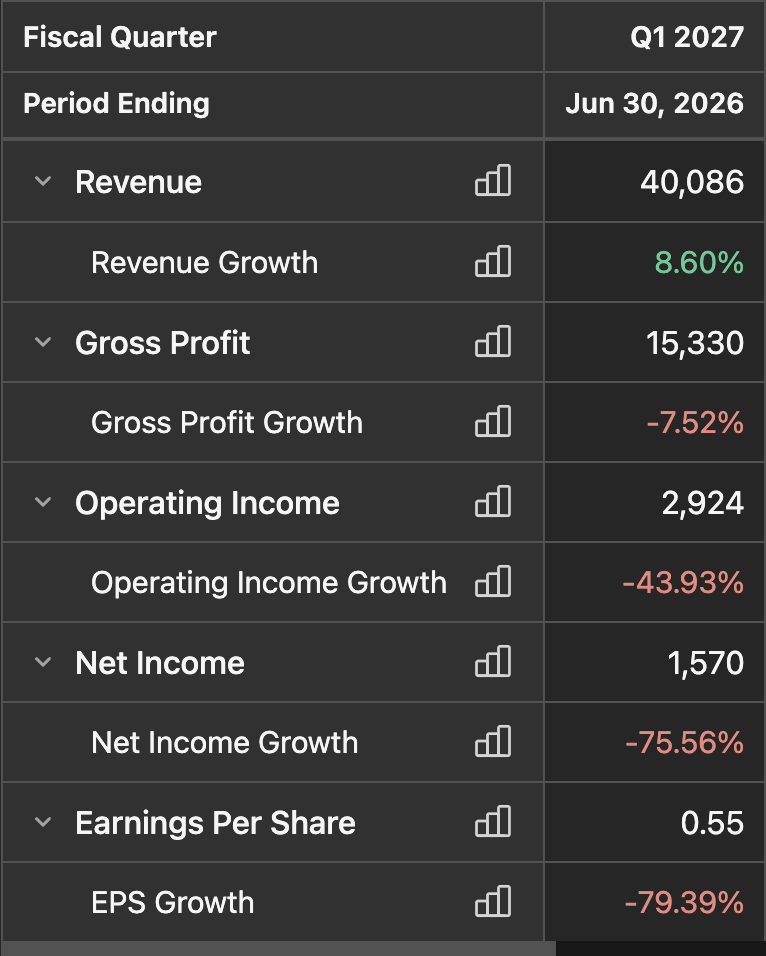
Looking at the Q1 2027 revenue and profits on stockanalysis.com, we see a 8.6% revenue growth YoY with a huge deceleration in the EPS and EPS growth rate to the tune of -79.39%. We will dig into more of the financials to discover reason for the drop, but gross profit, operating income and net income were all down in the last quarter.
Looking more granularly at business segments, we see a deceleration in the main cash cow e-commerce business of -8.25% YoY. I think this is mainly due to tough competition from domestic companies in that space, as management attributed this to weaker transaction activities.
Quick commerce saw some nice growth which management attributed to higher average value orders and enhanced fulfillment logistics efficiency while at the same time maintaining their market share. Specifically, they are focusing on high-value food orders and non-food categories.
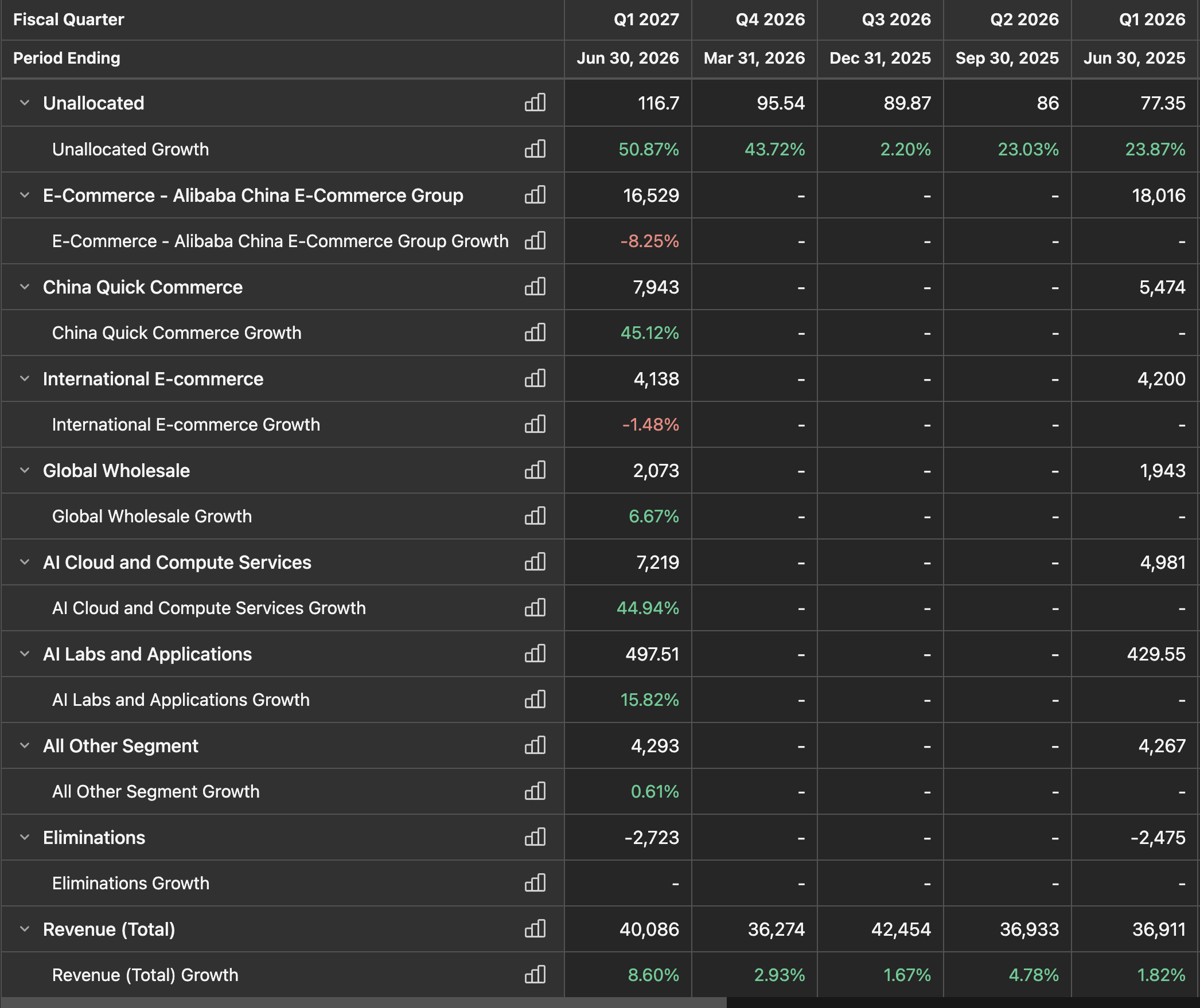
The real story is the growth in AI Cloud and Compute Services and AI Labs and Applications at 44.94% and 15.82%, respectively. This is a massive amount of growth in these business units, and I could see these groups becoming a larger and larger portion of the total revenue mix.
The newly combined AliCloud and T-Head division is accelerating nicely. In addition, the frontier model portfolio was upgraded recently with adjusted EBITDA loss narrowing QoQ.
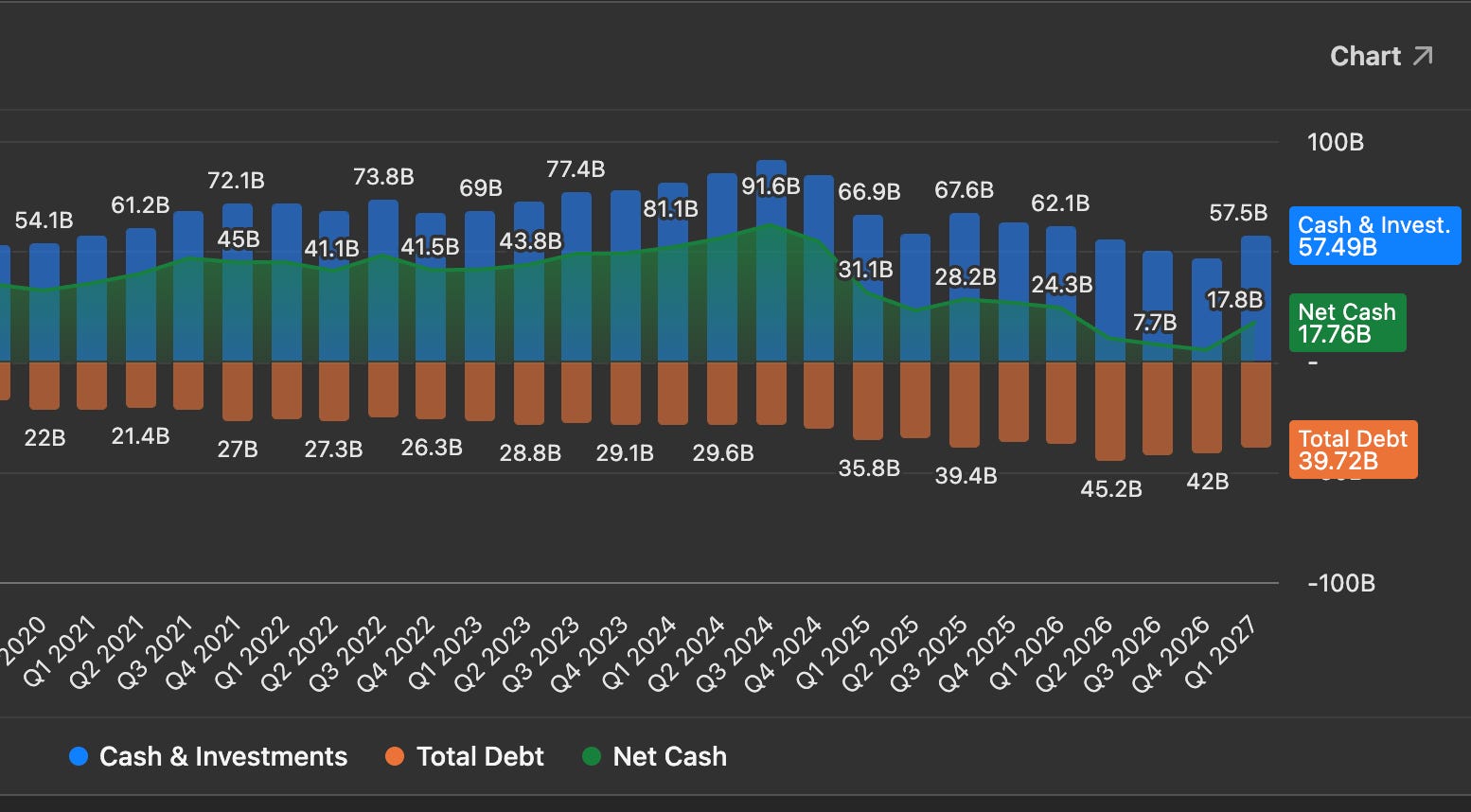
I shared in a recent note on BABA 0.00%↑ that their net cash position is still strong at ~$17.8B. However, the debt they are adding onto their balance sheet is increasing and needs to be monitored just in case we have a situation where net cash dips into the red.
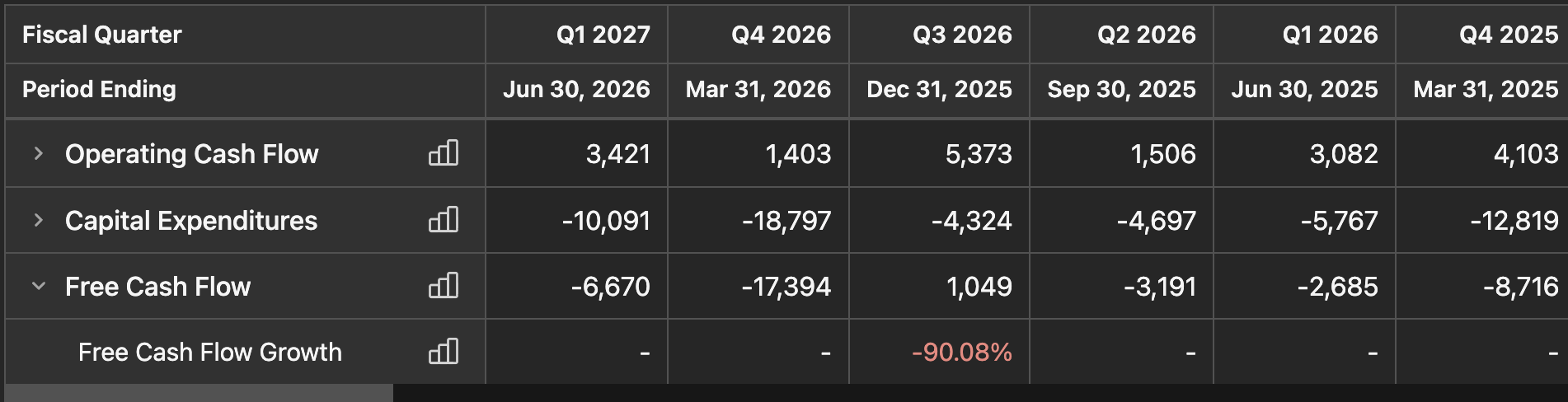
Speaking of red, free cash flows remain negative at -$6.67B. While this is less than ideal, it is par for the course for these big tech players both abroad and here in the US apparently. The negative free cash flow is due to incurring high capital expenditures. They had 75% higher capex YoY in the quarter ended in June 2026, spending roughly $9.975B.
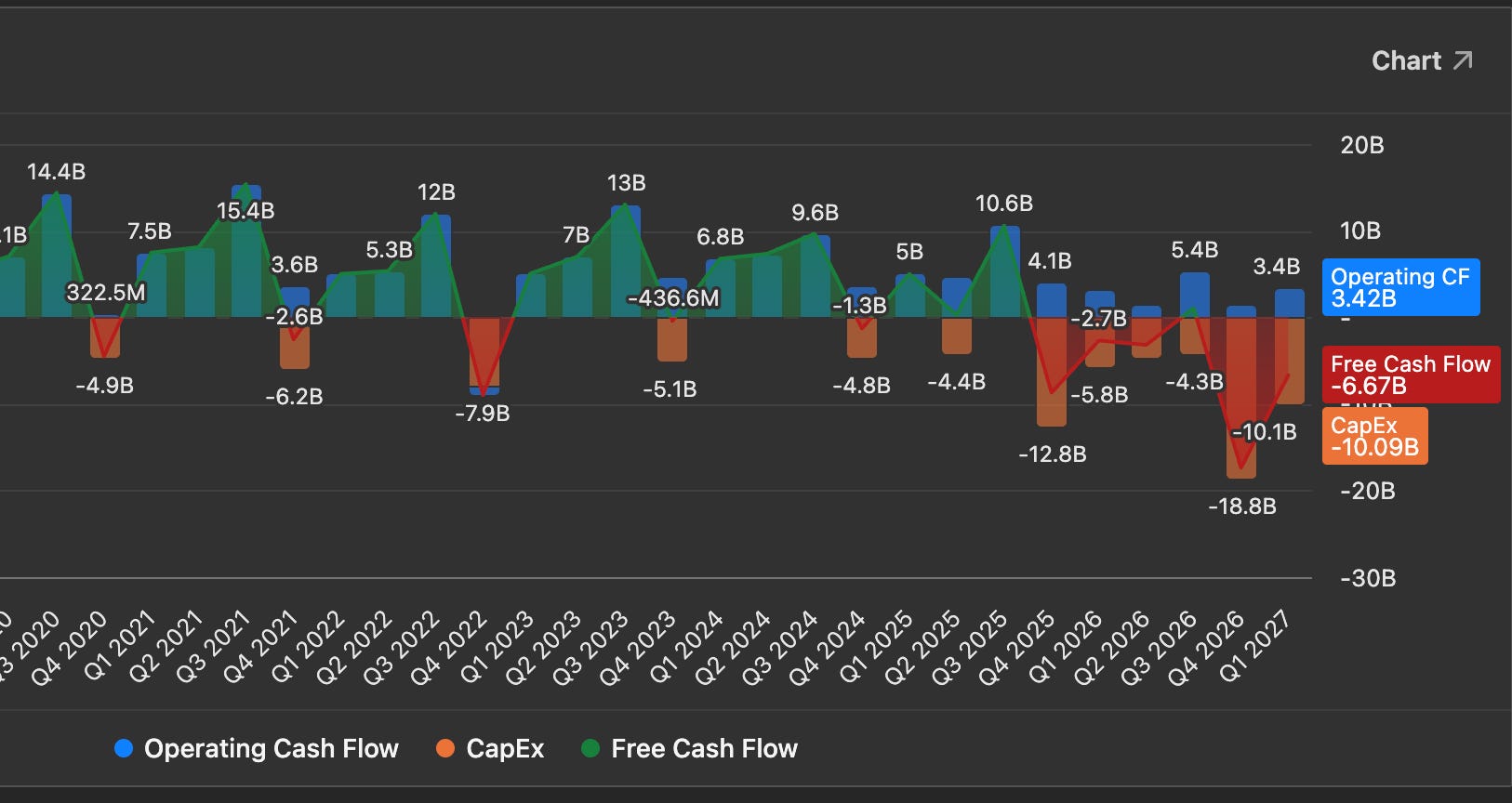
A clear trend is emerging from the data of their last earnings report. They are increasing AI infrastructure spend but developing AI infrastructure, AI models, AI labs, cloud and everything else quickly.
In my opinion, this is the reason for the temporary weakness in their net income, EPS and free cash flow, but will pay off in the long run if we are to believe the AI narrative as a whole.
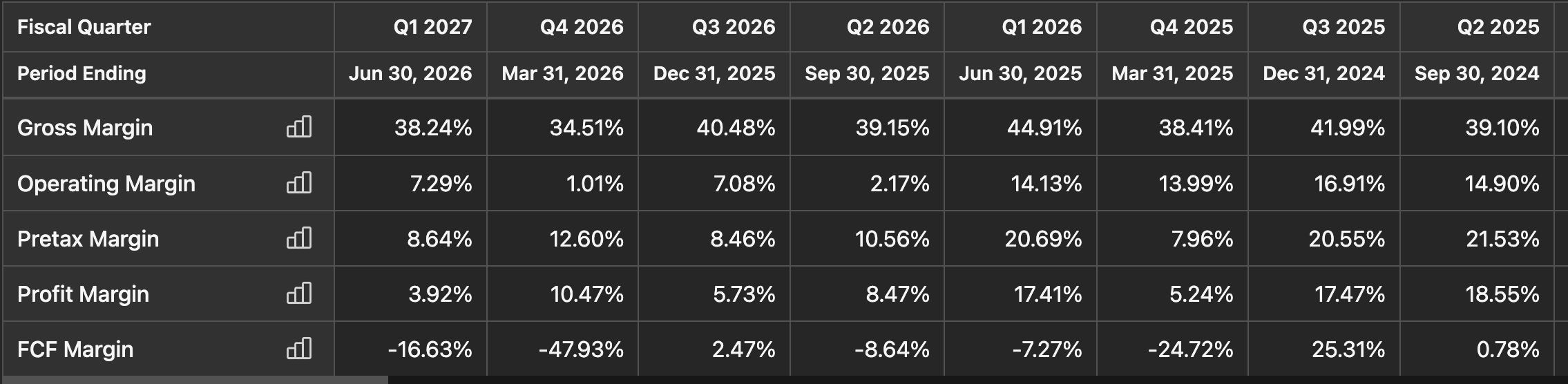
With the margins, you can see last quarter had a large discrepancy between operating and pre-tax margins which indicates a large amount of non-operating items. In the most recent quarter, it looks like the core business improved and there was less impact from those non-operating items.
Let’s take a look at their operating costs from their investor presentation.
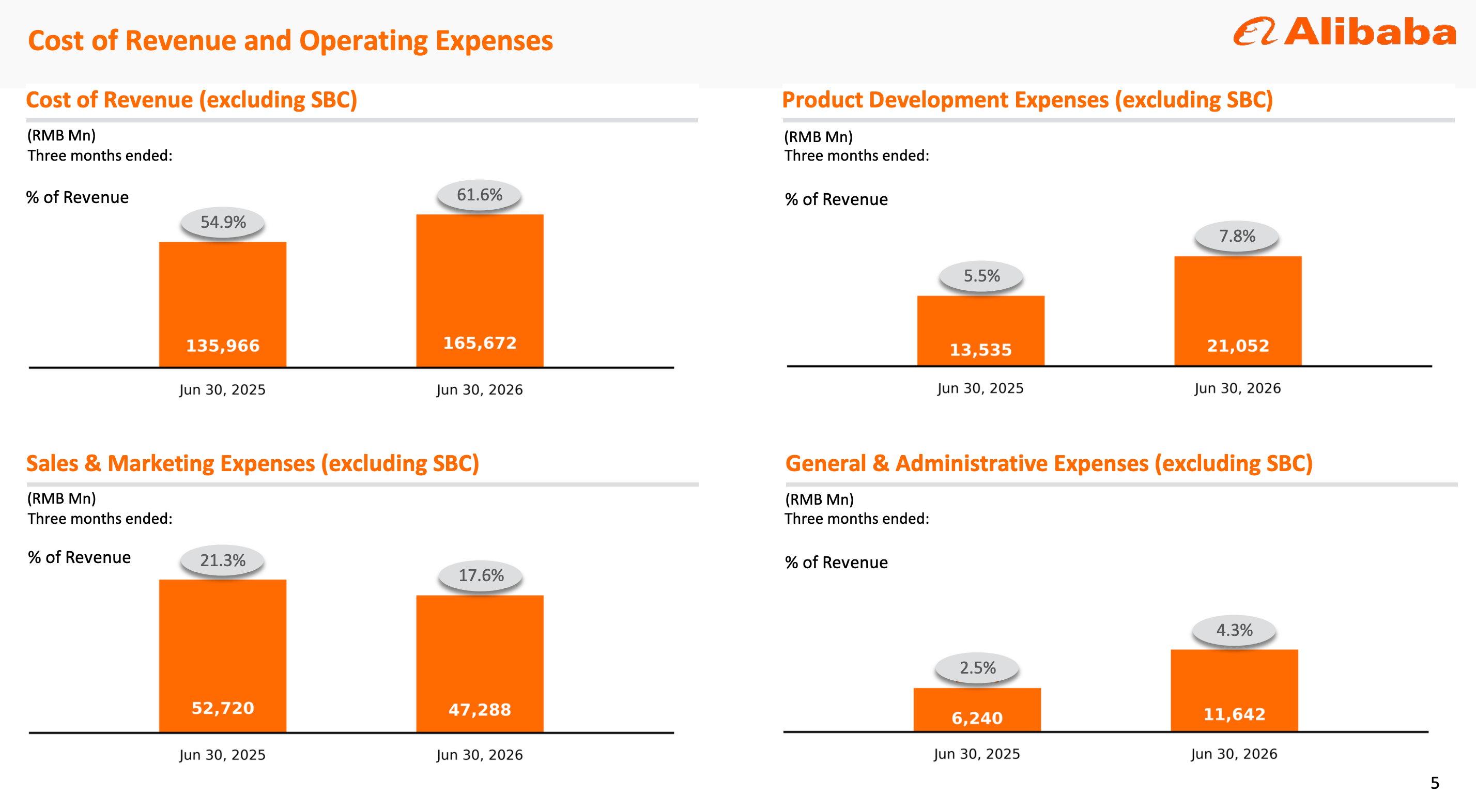
Importantly, it looks like they were able to actually reduce sales & marketing expenses YoY, but the other costs rose slightly. All of these are excluding stock based compensation.
However, the balance sheet still looks strong with net cash around $17.8B, cash and investments around $57.5B and total debt at $39.74B. This is all while their operating cash flow increased and capital expenditures decreased QoQ.
Lottery Tickets With AI & Cloud
Even though there seems to be some pain with negative free cash flow and some deceleration in parts of the main e-commerce business, there are many reasons to be optimistic on BABA 0.00%↑.
First, as discussed above, there is the rapid growth in the AI Cloud and Compute Services group. With the addition of T-Head to the business group, this unit is favorably positioned to continue being the largest cloud provider in China with 38.1% of the market in 2025.
Their proprietary chips like the Zhenwu line are being used by over 650 external customers through AliCloud further strengthening the synergies between T-Head and AliCloud.
In addition, they were able to launch a foundation model Qwen3.8-Max within three months of it’s prior version. As of this writing, they are up to a 2.4 trillion parameter model with Qwen 3.8-Max. It seems competitive with domestic rivals like Moonshot AI’s Kimi K3 and DeepSeek. The major takeaway is that they have an impressive fleet of models that do everything from audio, video, reasoning, image, code, multi-modal and more.
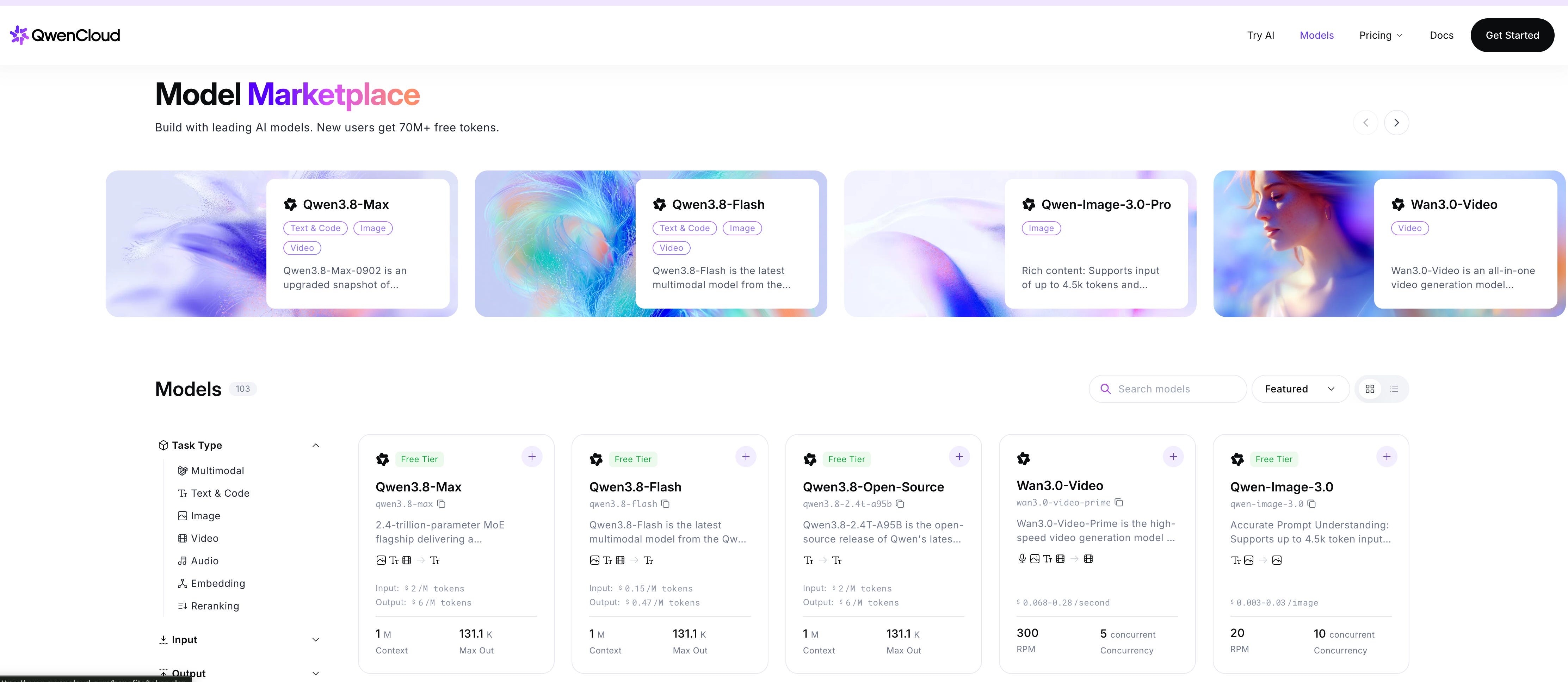
QwenWork is their version of agentic AI which works on the organizational and individual levels with it’s deep integration with AliCloud and DingTalk. QwenApp is like their ChatGPT for consumer AI where it is integrating with their e-commerce offerings through Tmall, Taobao and TaoBao Instant Commerce to drive sales and agentic AI use.
This flywheel approach across AI and e-commerce businesses unlocks new growth opportunities; they take that feedback and enhance their models and user experience with it.
On the capital allocation front, until just this past quarter, BABA 0.00%↑ was retiring shares left and right. They bought back over 200 million shares from FY 2023 to FY 2025. They slowed down the pace a lot in FY2026 predominantly because they reinvested into the business. But if they are able to start buying back shares in earnest again, that will start to drive up EPS.

Competition and Risks
There are real risks to be considered as well. The two main risks I can see are domestic competition with PDD 0.00%↑ and JD 0.00%↑ and geopolitical tensions.
BABA 0.00%↑ has a good hold on the cloud market share at roughly 38% but PDD 0.00%↑ and JD 0.00%↑ are nipping at the heels with an estimated 16% each currently. If the market share drops aggressively, then the cloud and AI business groups might not be able to offset weakness in the e-commerce business fast enough.
Geopolitics is always an issue when it comes to investing in equities based in foreign countries. Issues like what China will do with Taiwan, tariffs, country-level tech IP and more will dominate investor mindsets when looking at foreign assets. This will definitely impact investing patterns and can be a factor in what a stock may do after a bad or good earnings report.
Analyst Estimates and Valuation
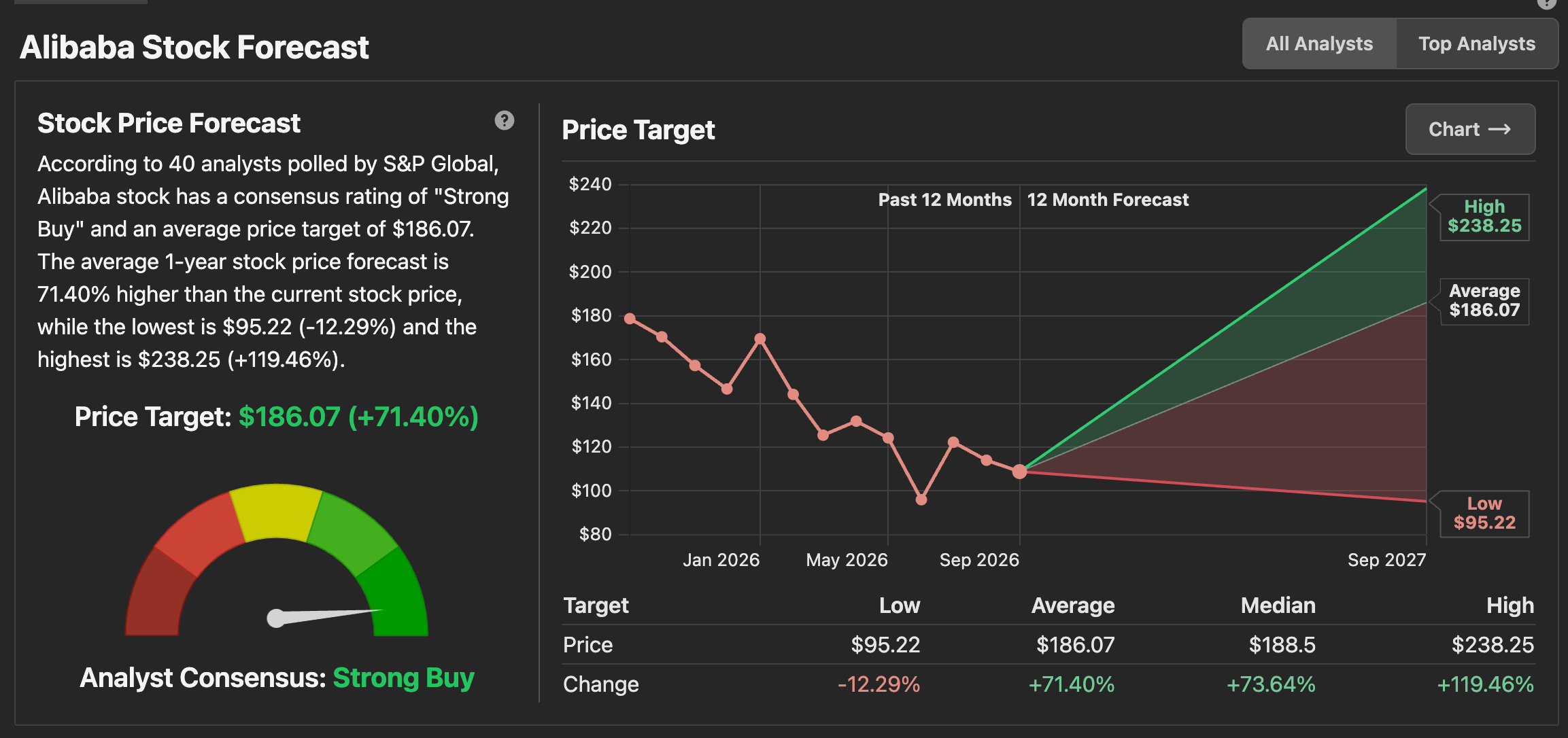
With BABA 0.00%↑ at roughly $108.6 a share right now, the market cap is around $269B. With an average price target around $186.07, analysts see a 71.4% upside in the stock from the current price.
Looking out to FY 2027 and beyond, analysts are anticipating increasing revenue growth to 14.22% in FY 2029. They also see very strong EPS growth in FY 2027 that tapers off in the following years but which is still higher than revenue growth rates.
Importantly, the projection of free cash flow seems to go positive in FY 2028 and beyond. While it is always difficult to make projections many years out, analysts seem to be positive (no pun intended) on positive free cash flow going forward.
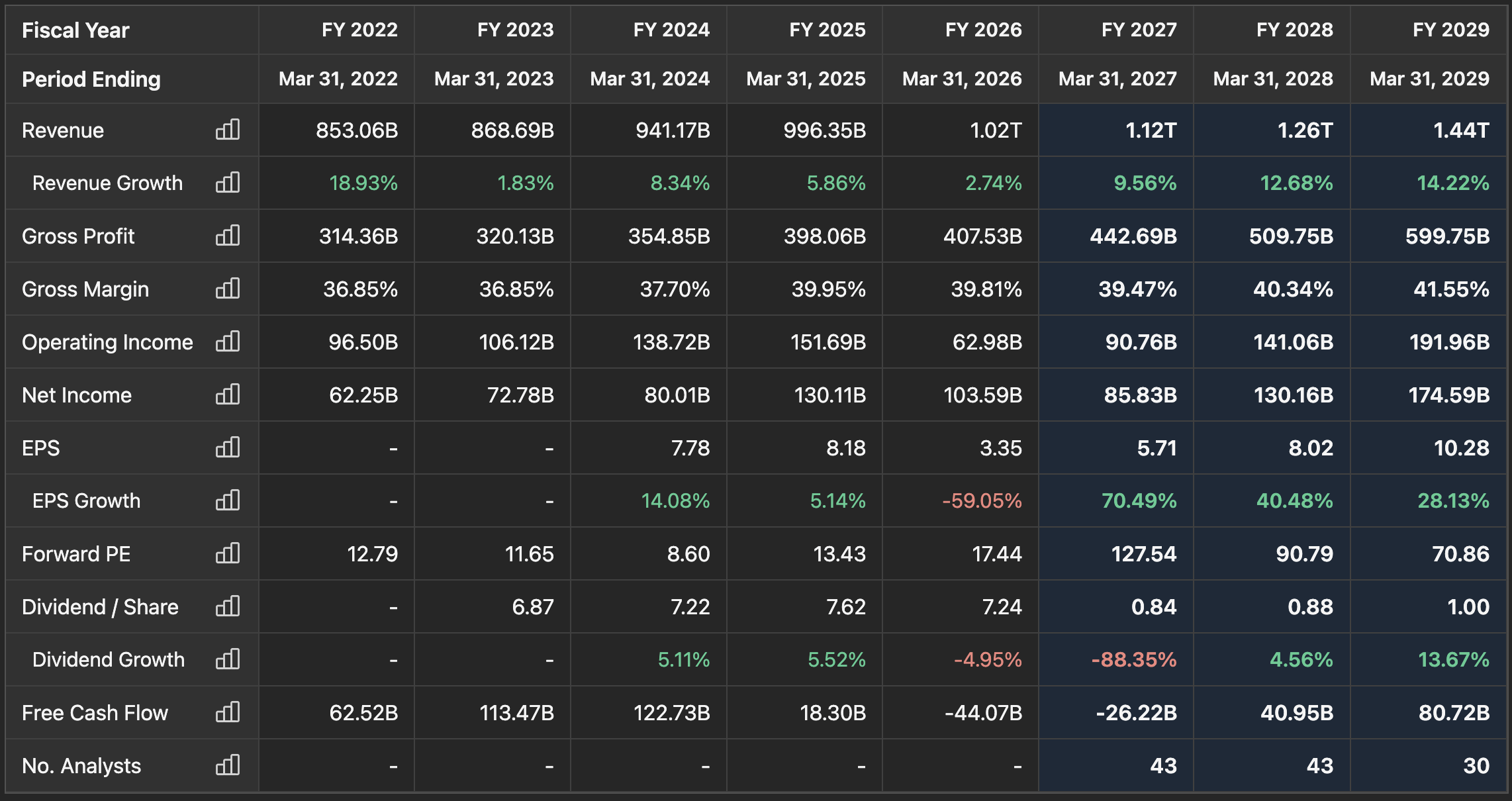
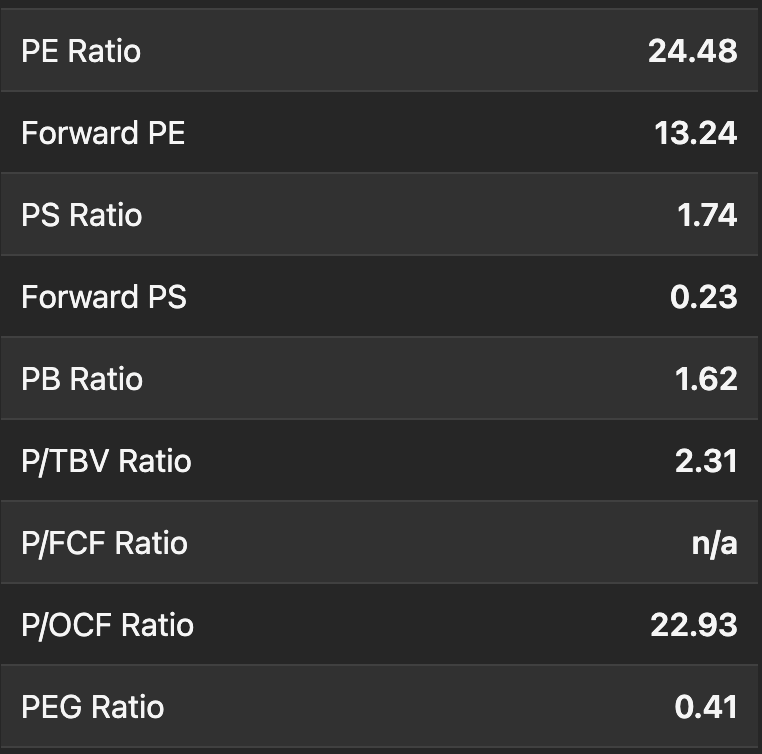
Looking at valuation ratios on stockanalysis.com, what stuck out to me is that the PEG ratio, or P/E over growth ratio, is only 0.41! As a reminder, a PEG ratio of 1.0 is about fairly valued, anything below 1.0 may indicate undervaluation, and anything above 1.0 may indicate overvaluation.
The current PE is 24.48 but the forward PE is at 13.24. This would be a ridiculous multiple if you assigned it to GOOG 0.00%↑ or AMZN 0.00%↑.
Bottom Line
I like the growth prospects of Qwen, QwenWork, QwenApp, AliCloud and other AI products and services, but I’m also monitoring their core e-commerce business growth. It is truly an amazing company in all that it does and continues to improve upon.
If BABA 0.00%↑ were to drop more and hit my targets ($90-$100 per share) for acquiring the stock (you have to acquire a great business at the right price), then I would be writing a portfolio update piece right now instead of a deep-dive article. Until then, this remains on my watchlist while I build my capital.
As always, my content is not financial advice and you should do your own due diligence before investing any of your money.